



By Racheal Nagawa
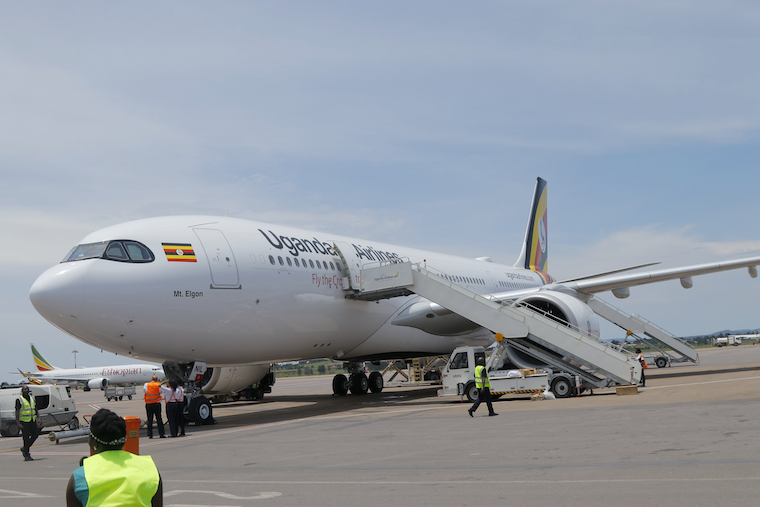
Uganda Airlines’ long-haul network has been thrown into turmoil after both of its Airbus A330-800neo aircraft were grounded for unscheduled maintenance, disrupting key international routes and raising fresh concerns about the carrier’s financial sustainability.
The disruption peaked on Friday morning when the scheduled Entebbe–London flight was cancelled after the second Airbus developed a technical fault. The incident compounded an already strained situation, as the first A330-800neo had been out of service for nearly a month.
In a public statement, Uganda Airlines said the disruptions were the result of “unscheduled maintenance” affecting its long-haul fleet.
“We understand that this may cause concern and inconvenience, and we want to assure all affected passengers that their safety and comfort remain our highest priority,” the airline stated.
The carrier said it is rebooking affected passengers on partner airlines where possible, consolidating some flights, and offering flexible rebooking options without change penalties. Passengers are being contacted directly via phone and email with revised travel details.
Technical teams are reportedly working “around the clock” to source necessary parts and expertise, but no clear timeline has been given for when the aircraft will return to service. Travellers on the London and Mumbai routes have been advised to regularly check flight status updates.
Leadership Shake-Up Amid Crisis
The fleet disruption comes just days after President Yoweri Museveni appointed Girma Wake as Advisor and Acting Chief Executive Officer of Uganda Airlines. Wake, a respected aviation executive and former head of Ethiopian Airlines, takes over at a time when the national carrier faces operational instability and mounting scrutiny.
His appointment followed the dismissal of former CEO Jenifer Bamuturaki, who was accused of procurement irregularities, weaknesses in maintenance oversight, financial losses, and poor communication during service disruptions.
Expansion Strategy Under Pressure
Uganda Airlines has in recent years expanded its international footprint, launching long-haul routes to London and Mumbai, in addition to Dubai and African destinations such as Lagos, Abuja, and Johannesburg.
The long-haul services are operated by two Airbus A330-800neo aircraft, while regional operations rely on four Bombardier CRJ-900LR jets. However, aviation analysts argue that the airline’s route expansion has outpaced fleet growth.
Operating only two wide-body aircraft leaves the airline vulnerable. Without a standby aircraft, even routine maintenance can cascade into cancellations and widespread passenger inconvenience. Industry experts note that while turnaround times of 90 to 120 minutes for long-haul aircraft are standard—and Uganda Airlines’ reported Gatwick turnaround times fall within that range—the real vulnerability lies in the absence of a fleet buffer.
Financial Losses Deepen Concerns
The operational challenges come against the backdrop of persistent financial losses. Since its revival in 2019, Uganda Airlines has relied heavily on government capital injections to sustain operations.
In recent financial disclosures, the airline reported significant annual losses running into hundreds of billions of shillings, attributed to high operating costs, debt servicing obligations, and the slow maturation of newly launched routes. Analysts warn that disruptions to high-yield long-haul routes such as London and Mumbai could further strain revenues, especially if passenger confidence declines.
Long-haul operations typically generate stronger margins compared to regional routes, meaning extended grounding of the A330-800neo fleet could have a disproportionate financial impact.
A Critical Test for New Leadership
For Girma Wake, the immediate priority will be restoring operational stability and rebuilding passenger trust. Beyond resolving the technical issues, the broader challenge will involve aligning fleet capacity with network ambitions, improving maintenance planning, and addressing structural financial losses.
Without strategic fleet expansion or leasing arrangements to provide backup capacity, experts caution that similar disruptions could recur—particularly as the airline continues to pursue an ambitious growth strategy.
As technical teams work to return the grounded aircraft to service, Uganda Airlines faces a defining moment: stabilise operations and chart a path to financial sustainability, or risk deeper turbulence ahead.
About the Author
Racheal Nagawa is a Ugandan business journalist specialising in aviation, finance, and public sector accountability. She reports on corporate governance, state enterprises, and infrastructure development across East Africa.