



By Racheal Nagawa
Egypt is rolling out a $4 billion plan to overhaul and expand its oil-refining sector, part of a broader effort to tighten energy security, cut the fuel import bill and capture more value from its hydrocarbon resources.
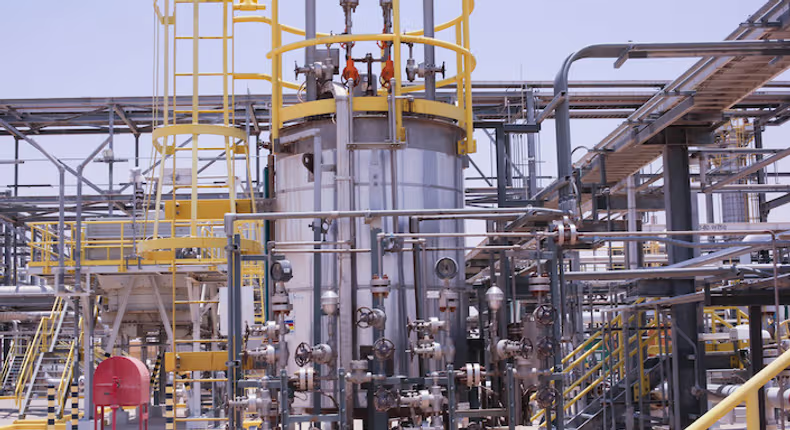
Minister of Petroleum and Mineral Resources Karim Badawi said the government has lined up six refinery-upgrade projects aimed at raising production capacity, improving efficiency and reducing reliance on imported refined products.
“The government has developed a strategy to increase the value added of existing oil refineries by implementing six projects requiring total investment of $4 billion to boost production capacity and reduce the fuel import bill,” Badawi said during talks with senior officials from the International Finance Corporation (IFC).
The discussions focused on potential financing and investment cooperation across refining, petrochemicals and mining, as Cairo seeks to draw more private capital into its downstream energy industries.
Bridging the refining gap
Egypt currently operates about 840,000 barrels per day (bpd) of nominal refining capacity across roughly a dozen facilities, most managed by the Egyptian General Petroleum Corporation (EGPC). However, aging infrastructure and maintenance constraints have reduced effective output to around 600,000 bpd.
That shortfall has forced the country to import significant volumes of refined fuel products to meet domestic demand — a costly exercise for a government already navigating fiscal pressures and reform commitments.
Among the country’s largest facilities are the Mostorod Refinery and the MIDOR Refinery, each capable of processing about 160,000 bpd. Modernisation efforts are expected to focus on improving operational reliability, increasing yields of high-value products such as diesel and gasoline, and eliminating production bottlenecks.
By upgrading existing assets rather than building entirely new ones, authorities hope to deliver quicker gains while containing costs.
Reform-driven momentum
The refinery investment drive comes against the backdrop of Egypt’s wider economic reform programme, implemented in partnership with the International Monetary Fund. Over the past few years, Cairo has taken politically sensitive steps, including scaling back fuel subsidies and liberalising fuel pricing mechanisms.
Those measures have helped ease the fiscal burden on the state and create room for targeted capital spending in strategic sectors such as energy infrastructure.
Badawi said the planned upgrades would “strengthen the national refining capacity, increase the added value in the region, and reduce fuel import costs,” underlining the government’s intent to keep more of the petroleum value chain within the domestic economy.
In parallel, the ministry is working to improve payment structures with exploration and production partners, encouraging higher output and ensuring consistent feedstock supply to local refineries.
Meeting rising demand
Egypt’s fuel consumption has climbed steadily, driven by industrial growth, infrastructure development and rising transportation needs in a country of more than 100 million people. Without sufficient refining capacity, the gap between domestic production and consumption has weighed on foreign currency reserves.
Closing that gap is central to Cairo’s ambition to position itself as a regional energy hub linking North Africa and the eastern Mediterranean. The country has already made strides in natural gas, including expanded production from the Zohr gas field and new offshore discoveries.
Strengthening refining capacity complements those upstream gains, allowing Egypt not only to meet local demand but also to explore opportunities for exporting refined products to neighbouring markets.
Attracting global partners
The involvement of the IFC highlights Egypt’s strategy of blending public investment with international financing and technical expertise. Officials also explored collaboration on projects designed to enhance environmental performance and energy efficiency — areas that are increasingly critical as investors weigh climate considerations alongside profitability.
Upgrading refineries offers opportunities to reduce emissions intensity, improve product quality and align operations with international standards, all while supporting industrial competitiveness.
For Cairo, the $4 billion refinery overhaul is more than an infrastructure upgrade. It represents a calculated move to reduce vulnerability to external fuel shocks, ease pressure on the trade balance and reinforce energy as a pillar of economic recovery.
As global energy markets remain volatile and emerging economies face tighter financing conditions, Egypt’s bet on modernising its refining backbone underscores a broader message: controlling more of the value chain at home can translate into greater resilience abroad.
About the Author
Racheal Nagawa is a senior reporter at Business Express Magazine with over a decade of experience covering economy, business, finance, entrepreneurship and African lifestyle across both print and electronic media.