



By Racheal Nagawa
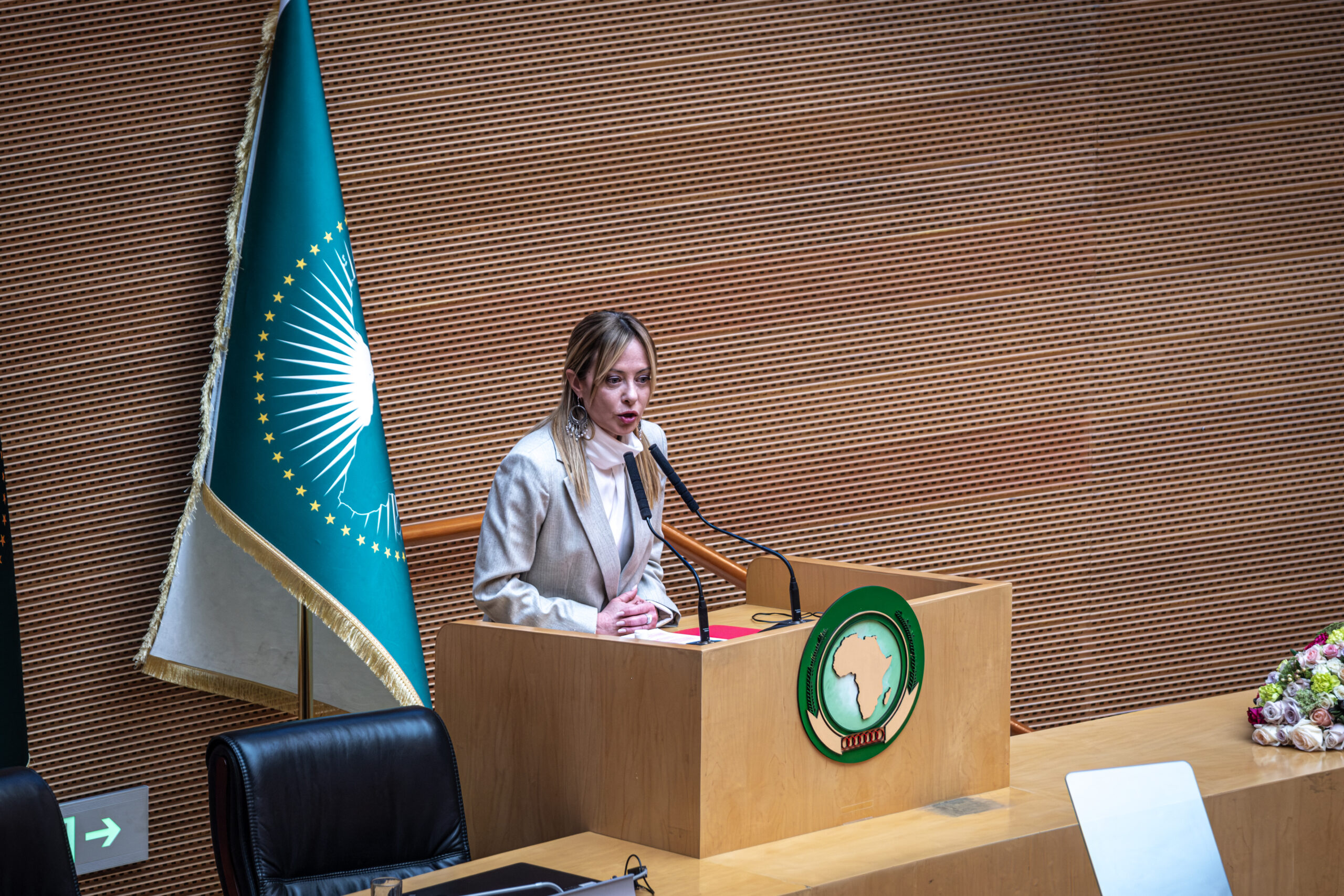
Italy’s Prime Minister, Giorgia Meloni, visited Ethiopia last week in a move widely seen as reinforcing Rome’s diplomatic and commercial engagement with Africa. The visit, which included participation in an Italy–Africa summit in Addis Ababa and an address at the headquarters of the African Union (AU), underscores Italy’s determination to position itself as a strategic partner to the continent.
The summit in Addis Ababa followed a previous gathering in Rome two years earlier, reflecting sustained high-level engagement between Italy and African states. Addressing AU officials, Meloni emphasized her government’s intention “to write a new chapter” in relations with Africa, built on trust, mutual respect, and shared prosperity.
Renewed Diplomatic Momentum
Since assuming office in October 2022, Meloni has placed Africa at the centre of her foreign policy agenda. Her early visits to Algeria, Libya, Tunisia, and Ethiopia signaled a clear shift toward strengthening Mediterranean and African partnerships.
Beyond diplomatic symbolism, Italy is pursuing concrete economic and strategic interests. The government sees deeper cooperation with African nations not only as a commercial opportunity but also as a means to address migration flows to Europe—one of Meloni’s core political priorities.
The Mattei Plan Takes Shape
At the heart of Italy’s Africa strategy lies the “Mattei Plan,” launched in January 2024. Named after Enrico Mattei, the founder of Italy’s national energy company, the initiative seeks to redefine Italy’s engagement with Africa through energy cooperation, infrastructure development, and broader economic partnerships.
A key component of the plan involves strengthening energy corridors between North Africa and Europe. Italy aims to expand pipeline infrastructure that would enable the export of natural gas and hydrogen to northern Europe, positioning Rome as a central energy hub while creating expanded market access for African producers.
Italian energy giant Eni—in which the Italian government is the largest shareholder—has already deepened its footprint across the continent. The company has announced multi-billion-euro investments in Algeria, Libya, and Egypt, alongside projects in the Democratic Republic of the Congo, Côte d’Ivoire, Ghana, and Mozambique, including liquefied natural gas (LNG) infrastructure initiatives.
From Vision to Implementation
When first unveiled, the Mattei Plan faced criticism for lacking operational detail. However, analysts now suggest the initiative has evolved. According to Federico Donelli, professor of international relations at the University of Trieste, the plan has gained greater clarity, with priority countries and sectoral pillars more clearly defined. Coordination with European Union instruments has also reportedly improved.
Speaking in Addis Ababa, Meloni asserted that the plan is no longer conceptual but operational, claiming it is already delivering tangible results for both Italy and African partners.
Yet questions remain regarding scale. Observers caution that Italy’s geopolitical ambitions in Africa may exceed its current financial commitments. While the Mattei Plan is expanding into sectors such as infrastructure, agriculture, education, and healthcare, energy cooperation continues to dominate its framework.
Competing in a Crowded Landscape
Italy’s renewed push into Africa unfolds against a backdrop of intense global competition. China’s financial leverage, France’s longstanding political and security networks, and the United States’ strategic influence all shape the continent’s geopolitical environment.
Compared to these powers, Italy operates with more limited structural leverage. Analysts argue that the long-term success of the Mattei Plan will depend on sustained funding, consistent political engagement, and measurable delivery.
If implemented effectively, Italy’s strategy could yield mutual economic benefits—particularly in energy transition and infrastructure development. However, without sustained commitment, the gap between Rome’s ambitions and its actual influence in Africa may persist.
Meloni’s Ethiopia visit therefore marks not only diplomatic outreach but also a test of Italy’s ability to translate vision into durable partnership across Africa.
About the Author
Racheal Nagawa is a business and geopolitical analyst specializing in African economic development, international trade, and global investment trends. She writes extensively on Africa–Europe relations, energy policy, and emerging markets.