



By Racheal Nagawa
In Uganda, the path from formal employment to entrepreneurship is often fraught with skepticism. For many, leaving a stable career to pursue business ventures seems like a gamble. But for Dr. Daniel Masaba, a young medical doctor, taking the leap into poultry farming has proven both profitable and transformative—not just for him but for the local communities he serves.
From Medicine to Farming: An Unconventional Journey
Fresh from medical school, Dr. Masaba began his career in the healthcare sector, driven by a desire to help people and serve his community. However, after a few months in practice, he recognized a stark reality: the pay for doctors in Uganda was modest, often limiting the scope of personal financial growth.
“Honestly, what we earn here as doctors is not the best,” he explains. “I had bigger ambitions. I wanted to create something sustainable, something that would have a long-term impact on society.”
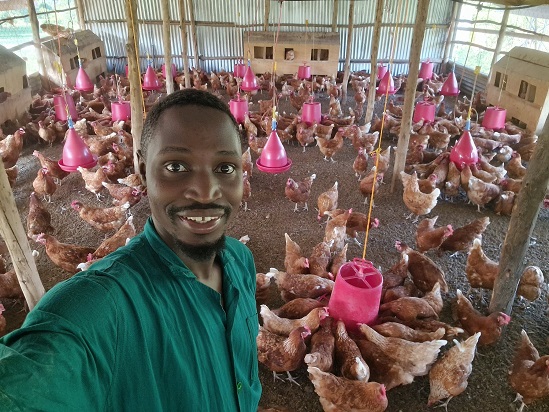
While initially considering greenhouse farming, a chance conversation with an agricultural expert redirected him toward poultry. In 2019, using savings accumulated from his medical salary, he purchased 750 birds and set up a semi-finished chicken structure on his father’s land.
At the outset, friends and colleagues thought his decision was risky, even “crazy.” “The farmers want to go back to school to become doctors, and here I am going the other way,” he recalls. “I believe I was crazy in a nice way. But I knew what I was doing.”
Building the Farm: Vision, Discipline, and Strategy
Starting small allowed Dr. Masaba to learn the intricacies of poultry management without overextending financially. After a year, he expanded his flock to 2,000 birds and began to see the business take shape. Today, Farm Up, his enterprise, spans 400 hectares, hatches over 120,000 chicks per week, and includes over 20,000 birds, alongside 300 goats, sheep, and 150 head of cattle.
Automation and strict biosecurity are hallmarks of the farm’s operations. Water and feed systems are largely automated, reducing human contact with the birds and minimizing disease risks. Even egg collection is semi-automated, allowing eggs to roll out of the structure without workers entering the pens.
“We designed the system so that disease exposure is minimized,” Dr. Masaba explains. “Not many people access the structure. Birds are delicate, and any unnecessary contact increases the risk.”
Financial and Operational Insights
Poultry farming at this scale requires meticulous planning and significant investment in feed, labor, and infrastructure. Despite growing over 200 hectares of maize for feed, Dr. Masaba notes that feed costs remain the biggest challenge, often fluctuating due to market volatility.
“Even when we grow our own maize, it is not enough to meet the demand of over 20,000 birds,” he says. “Feed costs can double or triple, affecting profitability and sometimes sales. Buyers may hesitate when prices rise, which directly impacts revenue.”
Labor management is another challenge. With over 100 employees dedicated to poultry alone, Dr. Masaba emphasizes training, trust, and accountability. “Workers are very complicated,” he admits. “You train them, and sometimes they leave. You trust them, and sometimes they betray that trust. Human resource management is one of the toughest parts of scaling a farm.”
Despite these challenges, the farm has become financially rewarding. By vertically integrating operations—from feed production to automated poultry systems—Dr. Masaba has reduced operational costs and maximized efficiency.
Impact Beyond Profits
For Dr. Masaba, the choice to focus on agriculture was not only financial. He sees farming as a way of life with a broader societal impact. “Everyone needs food,” he explains. “Farming allows me to provide nutrition, create employment, and support communities. On special days, we distribute livestock to villages, and seeing the direct impact of the farm on people’s lives is incredibly fulfilling.”
His model also demonstrates how modern agricultural practices can coexist with large-scale commercial farming. By incorporating automation and proper biosecurity measures, he has set a benchmark for professionalism in Ugandan poultry farming—a sector often characterized by small-scale, informal operations.
Lessons from Dr. Masaba’s Success
Several lessons emerge from his journey:
Start Small, Scale Gradually
Dr. Masaba began with 750 birds and limited resources. This allowed him to learn without incurring excessive losses. Gradual scaling ensured that he could reinvest profits into infrastructure, automation, and livestock expansion.
Leverage Expertise and Networks
Although a doctor by training, he sought guidance from agricultural experts. Networking with experienced farmers and advisers helped him understand best practices, avoid common pitfalls, and make informed business decisions.
Invest in Systems and Technology
Automation has been critical to Farm Up’s success. Systems that minimize human contact reduce disease risks, improve productivity, and allow the farm to operate efficiently with a large flock.
Adapt and Persevere
Dr. Masaba emphasizes the need for resilience. Poultry farming comes with unpredictable challenges—from feed price fluctuations to disease outbreaks. Flexibility and the ability to adapt quickly are essential for long-term success.
Commit to Impact
Beyond profit, Dr. Masaba considers the social impact of his work. Providing food, creating employment, and supporting local communities has become as important as financial returns.
The Bigger Picture: Agriculture as a Path for Young Professionals
Dr. Masaba’s story reflects a larger trend in Uganda and across Africa. Young professionals are increasingly exploring agriculture as a viable career, blending traditional practices with modern business and technology. Sectors like poultry, aquaculture, and horticulture are proving lucrative, particularly when combined with automation, quality control, and market access.
Government initiatives, including subsidies, training programs, and access to financing, are helping to strengthen small and medium-sized agricultural enterprises. However, Dr. Masaba notes that more support is needed for small-scale farmers, particularly in creating consistent markets for their products.
Advice to Aspiring Entrepreneurs
Dr. Masaba encourages anyone interested in agriculture to begin with vision, commitment, and a willingness to learn. “Poultry has nothing to do with where you start,” he says. “What matters is having principles, some resources, and the determination to push through challenges. Save, research, learn from others, and be fully committed.”
He also underscores the importance of risk management and biosecurity, particularly for poultry businesses. Limiting contact with birds, automating feeding systems, and controlling environmental conditions are critical for maintaining flock health and ensuring profitability.
Looking Ahead
Farm Up is not just a farm—it is a model for what disciplined, innovative, and strategic agriculture can achieve in Uganda. With plans to expand production, integrate additional livestock, and continue innovating with automation, Dr. Masaba envisions a future where his farm not only generates revenue but serves as a blueprint for other young entrepreneurs.
“The beauty of farming is that it has no ceiling,” he says. “People look at successes abroad and think it’s unattainable. But anyone can do this. With focus, heart, and knowledge, you can create a business that feeds people, creates jobs, and makes a difference.”
Dr. Masaba’s story is a testament to courage, vision, and the power of combining passion with strategy. From a young doctor seeking an alternative to low pay, he has built an agricultural empire that proves opportunity lies where innovation, discipline, and commitment meet.
About the Author
Racheal Nagawa is a Ugandan business journalist focusing on entrepreneurship, agriculture, and SME growth. She highlights the stories of innovators transforming East Africa’s economy and provides practical insights for young professionals seeking to start and scale their ventures.