



By Racheal Nagawa
Equity Bank Uganda has reinforced its commitment to sustainable finance after completing an intensive capacity-building program under the Uganda Green Enterprise Finance Accelerator (UGEFA), positioning itself to better mobilize green capital and serve environmentally focused enterprises.
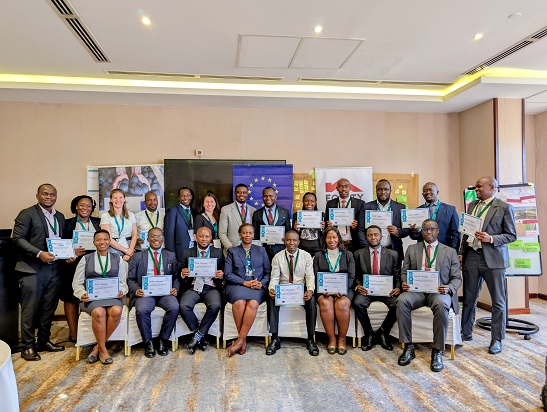
The three-day Green Loan Product Development Training, facilitated by UGEFA’s Green Finance Experts, brought together 20 staff members drawn from key operational departments across the bank. Participants represented Product Development, Finance, Environmental, Social and Governance (ESG) and Sustainability, Public Sector and Social Investment, Credit, Front Office, Risk, Reporting and Data, Marketing, and Branch Operations.
Held at Golden Tulip Hotel in Kampala, the program concluded with a graduation ceremony where participants received certificates in recognition of their newly acquired competencies.
The training was designed to equip SME-focused teams with practical tools to design green loan products that are commercially viable while delivering measurable environmental impact. Participants were taken through essential components of green finance product development, including eligibility criteria, climate risk assessment, pricing models, credit structuring, and go-to-market strategies.
Uganda’s green SME sector continues to face significant barriers to financing. Many environmentally focused enterprises struggle with limited collateral, insufficient credit histories, and longer investment payback periods typical of renewable energy and climate-smart projects. These constraints have slowed the growth of sustainable businesses despite increasing demand for green solutions.
For financial institutions, the segment has traditionally presented challenges such as high transaction costs, limited familiarity with emerging green technologies, and perceived credit risk exposure. However, evolving regulatory frameworks and growing investor interest in sustainable finance are shifting the landscape. Uganda’s National Green Taxonomy, alongside climate risk disclosure requirements, is creating clearer guidance for banks seeking to align with national and global sustainability standards.
By developing tailored green loan products, banks can unlock new market segments, strengthen ESG compliance, attract concessional funding, and position themselves as leaders in the expanding sustainable finance ecosystem.
Speaking at the graduation ceremony, Catherine Psomgen, Director of Public Sector and Social Investment at Equity Bank Uganda, underscored the value of strategic partnerships and regulatory alignment in advancing green finance.
“As a bank, we appreciate the partnership we have with the European Union and adelphi GLOBAL under the UGEFA Project. We have learned the importance of scoping opportunities within the regulatory terrain in which we operate. Compliance with frameworks such as the Green Taxonomy and climate risk regulations is essential. We must demonstrate that we are building a sustainable organization,” she said.
Psomgen reaffirmed the bank’s commitment to translating training outcomes into measurable results, particularly in scaling refinancing opportunities and expanding green lending portfolios.
Virginia Ssemakula, Pillar Head for Energy, Environment and Climate Change at Equity Bank Uganda, emphasized that internal technical expertise is central to scaling sustainable finance solutions. Strengthening staff capacity, she noted, enables the bank to structure green financial products confidently and responsibly while aligning with both market needs and climate priorities.
The training concluded with participants developing a practical foundation for a bank-ready green loan product and strengthening the institution’s internal framework for mobilizing climate finance.
Through its partnership with UGEFA, Equity Bank Uganda is not only enhancing its product offerings but also positioning itself as a catalyst for Uganda’s green enterprise growth and broader sustainable development agenda.
About the Author
Racheal Nagawa is a Ugandan business journalist specializing in finance, sustainability, and public sector development. She reports on banking innovation, investment trends, and economic policy across East Africa.