




By Racheal Nagawa
The Democratic Republic of the Congo’s mineral-rich subsoil has become the center of an international standoff as U.S.-based KoBold Metals, backed by Jeff Bezos and Bill Gates, seeks access to century-old geological records housed in Belgium. The documents, dating back to the colonial era, are considered crucial for mapping deposits of lithium, cobalt, and copper, minerals central to the global energy transition.
KoBold Metals, which has exploration agreements with Kinshasa to assess lithium potential in the southern Manono region, says the archives are essential for deploying its artificial intelligence-powered exploration tools. Without access to the historical data, the company says it cannot effectively evaluate the country’s geological prospects or optimize its exploration strategy.
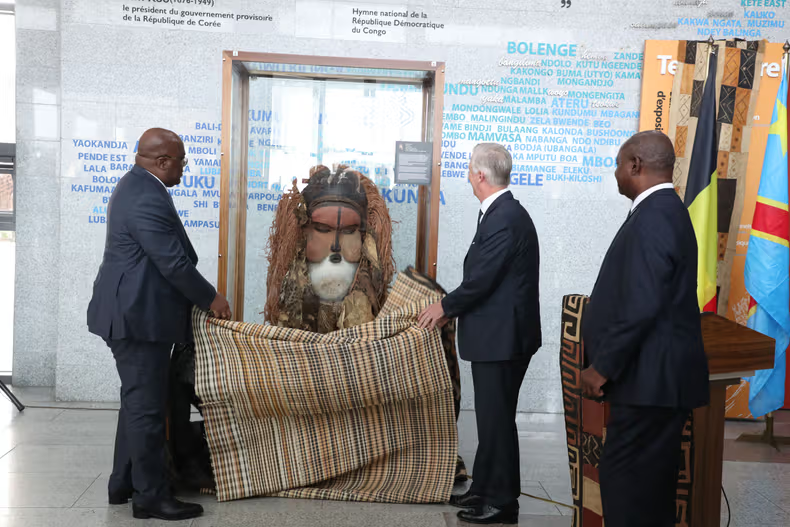


Belgian authorities and museum officials, however, have refused to release the archives until a full public digitization process is completed. They argue that allowing a private company to control the digitization would create an unfair commercial advantage and conflict with the museum’s public scientific mandate.
Historical records at the center of modern ambitions
The archives are held at Belgium’s Royal Museum for Central Africa, also known as the Africa Museum in Tervuren. The documents were originally compiled during Belgium’s colonial administration and contain detailed records on mineral deposits that were often overlooked at the time. Museum officials acknowledge their value but stress that the records alone cannot serve as precise maps for modern mining. François Kervyn, head of the museum’s Earth Sciences department, explained that “there is no map that tells you to dig here or there and you will find lithium,” emphasizing the limitations of historical data for contemporary exploration.
Museum director Bart Ouvry noted that while the data is historically significant, access must be managed carefully to preserve its integrity and ensure fairness. Belgium has pledged to return the archives to the Congolese government once digitization is complete. KoBold has requested permission to conduct the digitization in-house to speed up its exploration timeline, but the museum has rejected the proposal.
Tensions between public science and private enterprise
The dispute underscores the growing tension between scientific custodianship and commercial urgency. KoBold Metals recently raised $537 million in new funding to scale its AI-driven search for critical minerals worldwide. The company aims to deploy this technology across five continents, making timely access to the Congolese data particularly pressing.
In July 2025, Kinshasa and KoBold signed an agreement to expand public access to historical geoscientific data through the National Geological Service of Congo. The deal envisaged a KoBold team assisting with digitization at the Africa Museum under government supervision. However, Belgium’s Science Policy Minister Vanessa Matz has maintained that Brussels retains ultimate authority over the archives until the digitization process is complete. The European Union has committed funding to support the broader digitization effort, which is expected to take several years to complete.
Strategic stakes in global energy
The standoff over the archives highlights the strategic importance of Africa’s mineral wealth in the global clean energy transition. Lithium, cobalt, and copper are essential for batteries, electric vehicles, and other technologies central to reducing carbon emissions. Access to historical geological data can significantly reduce the time and cost of exploration, making these archives highly sought after by private firms with advanced AI capabilities.
KoBold argues that without timely access, the company risks missing opportunities to efficiently locate critical mineral deposits in the DRC. Belgian authorities, meanwhile, insist that a careful, publicly accountable digitization process is necessary to protect scientific and historical integrity.
Looking ahead
Archivists and scientists began the cataloging and digitization process in February 2026, with a larger team scheduled to join in March. The process could take years before the data becomes widely accessible. For investors, policymakers, and the mining sector, the outcome will have far-reaching implications, not only for AI-driven exploration but also for the ongoing debate over ownership of colonial-era scientific data in Africa.
The Congo, one of the world’s richest mineral countries, has long struggled with balancing foreign investment with national control over its resources. The KoBold dispute highlights the challenges governments face in managing historical data while promoting economic development and technological innovation.
About the Author
Racheal Nagawa is a senior reporter at Business Express Magazine with over a decade of experience covering economy, business, finance, entrepreneurship, and African lifestyle across print and electronic media.