



By Racheal Nagawa
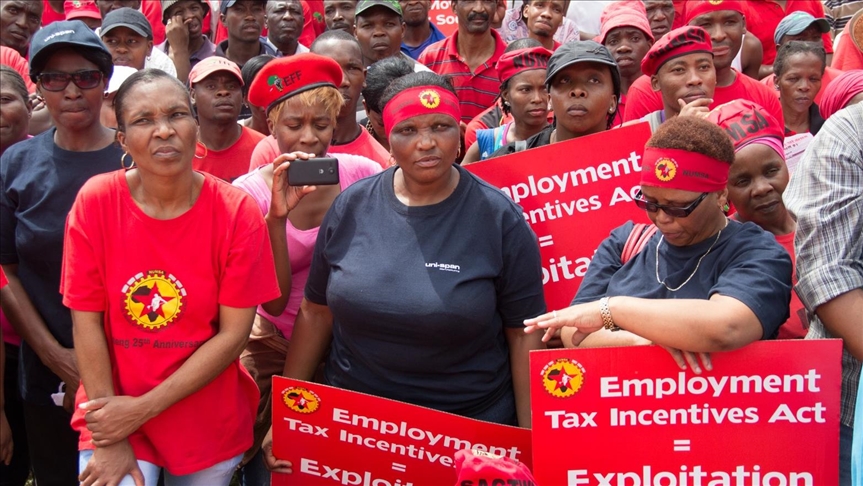
South Africa’s unemployment rate declined to its lowest level in more than five years in the final quarter of 2025, offering a rare note of optimism for an economy long burdened by stubbornly high joblessness.
According to Statistics South Africa, the official unemployment rate fell to 31.4 percent in the three months to December, down from 31.9 percent in the previous quarter. While the drop is modest, it marks the lowest reading since 2020, when the COVID-19 pandemic sent shockwaves through the labour market.
The improvement was largely driven by employment gains in the community and social services sector, alongside a rebound in construction activity. Economists surveyed ahead of the release had anticipated a slightly higher rate of 31.7 percent, making the outcome marginally better than expected.
Yet beneath the headline figure lies a more complex reality.
A fragile recovery
South Africa remains one of the countries with the highest unemployment rates globally. More than 8.4 million people are still actively seeking work. Since the height of the pandemic in 2020, the jobless rate has consistently hovered above 30 percent, underscoring the structural weaknesses in the economy.
As Africa’s largest economy, with an estimated gross domestic product of about $410 billion in 2025, South Africa carries the dual weight of continental economic leadership and domestic socio-economic strain. Its scale brings opportunity, but it also amplifies the urgency of delivering jobs to millions of unemployed citizens.
The recent gains in construction suggest some recovery in infrastructure activity, while hiring in community and social services points to public-sector and non-profit absorption of labour. However, analysts caution that these sectors alone cannot sustainably resolve South Africa’s employment crisis without broader private-sector expansion.
Youth unemployment remains acute
The broader unemployment rate tells only part of the story. Youth unemployment remains particularly severe, with young people disproportionately represented among job seekers. This has fuelled social frustration and heightened political pressure on the government to accelerate reforms.
In response, authorities announced plans in October to roll out a 2.5 billion rand (approximately $135 million) Youth Fund. The initiative aims to provide loans, business support and funding for small enterprises, with the goal of stimulating entrepreneurship and job creation among younger South Africans.
Small and medium-sized enterprises are widely seen as critical to unlocking employment growth in a country where large corporations alone cannot absorb the expanding labour force.
Migration and mounting tensions
At the same time, economic pressures have sharpened public debate around migration. South Africa continues to attract job seekers from neighbouring countries such as Zimbabwe and Mozambique, reinforcing its status as a regional economic hub.
However, rising unemployment has intensified political sensitivity around foreign labour. The government has stepped up deportations of undocumented migrants amid growing public frustration over job scarcity. Critics warn that while enforcement may address immediate political concerns, it does little to tackle the structural causes of unemployment, including skills mismatches, weak growth and persistent energy constraints.
Reform agenda under scrutiny
President Cyril Ramaphosa has repeatedly pledged to accelerate economic reforms aimed at boosting growth, restoring investor confidence and improving public-sector efficiency. Key priorities include easing regulatory bottlenecks, stabilising electricity supply and strengthening state-owned enterprises.
Energy reliability, in particular, remains central to job creation prospects. Years of power shortages and load-shedding have constrained business expansion, discouraged investment and weighed heavily on manufacturing output.
Finance Minister Enoch Godongwana is expected to provide further clarity on the government’s employment strategy when he presents the national budget on February 25. Investors and analysts will be closely watching for signals on fiscal consolidation, infrastructure investment and support for private-sector growth.
Balancing optimism with realism
While the drop to 31.4 percent offers encouragement, economists caution against overstating the improvement. The labour market remains fragile, and economic growth has been uneven. Without sustained expansion across key sectors such as manufacturing, mining, technology and services, employment gains could prove temporary.
Moreover, broader global headwinds — including slowing demand in major export markets and volatile commodity prices — continue to pose risks to South Africa’s recovery trajectory.
Still, the latest data provides a measure of hope in a country where joblessness has become both an economic and social fault line. Even incremental progress matters in an environment where millions remain excluded from formal employment.
For policymakers, the challenge now is to translate short-term labour market improvements into durable, inclusive growth — one that not only lowers unemployment statistics but meaningfully expands economic participation.
About the Author
Racheal Nagawa is a senior reporter at Business Express Magazine with over a decade of experience covering economy, business, finance, entrepreneurship and African lifestyle across both print and electronic media.