



By Racheal Nagawa
The International Monetary Fund (IMF) has approved a fresh $33.2 million disbursement to Burkina Faso after concluding the fourth review of the country’s Extended Credit Facility (ECF) programme, reinforcing international backing for the West African nation at a time of fragile stability and cautious economic recovery.
The funding signals continued confidence in Ouagadougou’s reform agenda, even as the country grapples with persistent security threats and humanitarian pressures linked to unrest in the Sahel region.
Alongside the disbursement, the Washington-based lender also approved a new Resilience and Sustainability Facility (RSF) valued at about $124.3 million. The facility, which will run through September 2027, is designed to strengthen climate adaptation efforts and support agricultural stability in one of the world’s most climate-vulnerable regions.
Gold surge reshapes the economy
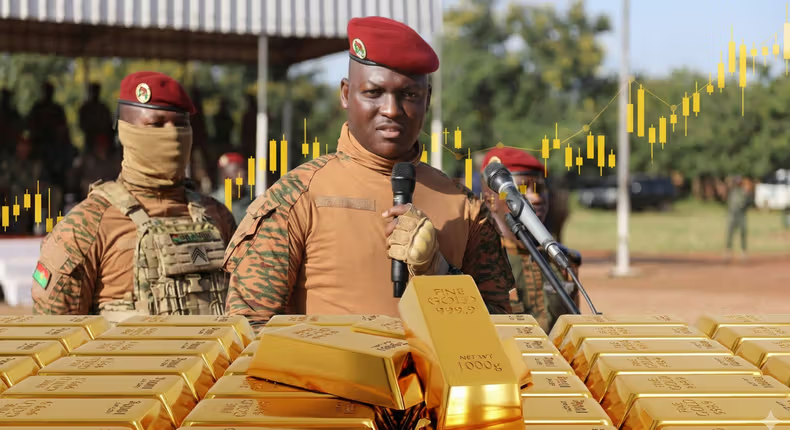
Burkina Faso’s improving macroeconomic outlook is largely tied to a remarkable surge in gold production. The country recorded a historic 94 tonnes of gold output in 2025, buoyed by sweeping mining sector reforms, firmer state oversight and a renewed push for resource sovereignty under the leadership of Captain Ibrahim Traoré.
Rising global gold prices have amplified the impact of these reforms, transforming the country’s external position. According to IMF projections, Burkina Faso’s current account is expected to shift into a surplus of 1.1 percent of GDP in 2025 and 0.8 percent in 2026 — a notable turnaround from previous deficits.
The mining boom has provided critical foreign exchange inflows, easing pressure on public finances and helping to stabilise the currency within the West African CFA franc zone.
IMF Deputy Managing Director Kenji Okamura said the economy has demonstrated resilience despite significant challenges. Improved governance measures and stronger domestic revenue mobilisation, he noted, have helped expand fiscal space while keeping inflation relatively contained and public debt on a sustainable path.
Climate resilience at the centre
Beyond gold revenues and fiscal stability, the newly approved RSF places climate resilience at the heart of Burkina Faso’s reform programme.
Roughly 80 percent of the population depends on subsistence farming, leaving livelihoods highly exposed to erratic rainfall, prolonged droughts and flooding. Climate shocks frequently disrupt harvests, strain food supplies and force costly emergency imports.
The RSF funding is expected to bolster agricultural adaptation initiatives, improve irrigation systems and strengthen disaster risk financing frameworks. By reducing vulnerability to climate extremes, authorities hope to limit future fiscal shocks and humanitarian emergencies.
For a country already managing internal displacement and food insecurity linked to insecurity in parts of the Sahel, strengthening climate resilience is increasingly viewed as an economic imperative rather than an environmental luxury.
Governance reforms under scrutiny
While praising progress, the IMF cautioned that governance reforms remain incomplete. Authorities have implemented six of eleven priority recommendations outlined in the Governance Diagnostic Assessment. Among the completed steps are measures aimed at strengthening transparency and integrity in mining licence allocations — a sector long viewed as both an economic engine and a governance risk.
The government has pledged to deepen oversight, enhance anti-corruption safeguards and broaden the domestic tax base to reduce reliance on external borrowing.
Fiscal consolidation also remains on the agenda. Ouagadougou has committed to targeting a budget deficit ceiling of 3.5 percent of GDP while safeguarding essential spending on health, social protection and security. Balancing these priorities will be delicate, particularly in an environment of ongoing military expenditure and humanitarian needs.
Growth outlook tied to security
The IMF projects economic growth of around 5 percent in 2026. However, that forecast hinges heavily on improvements in the domestic security environment.
Burkina Faso continues to face insurgent violence that has disrupted economic activity in several regions, displaced communities and strained public resources. Stability remains a prerequisite for sustaining investor confidence and ensuring that mining and agricultural gains translate into broader development outcomes.
Still, the latest IMF approval suggests that international partners see credible progress in economic management. The ECF arrangement, originally approved in September 2023, spans 48 months and is intended to anchor reforms that promote macroeconomic stability and inclusive growth.
A shifting narrative in the Sahel
Burkina Faso’s gold-driven rebound comes at a time when several Sahel economies are reassessing their development strategies amid geopolitical shifts and changing alliances. Greater state control over strategic resources has become a recurring theme across parts of West Africa, as governments seek to capture more value from extractive industries.
In Burkina Faso’s case, higher gold output and favourable global prices have provided breathing room. But economists caution that commodity-led gains can be volatile if not accompanied by broader diversification and institutional strengthening.
For now, however, the combination of mining reforms, improved fiscal discipline and targeted climate financing offers a measure of cautious optimism.
Whether that momentum can be sustained will depend not only on gold prices and rainfall patterns, but also on governance continuity and a gradual easing of security tensions.
As Burkina Faso navigates these intersecting pressures, the latest IMF support provides both financial relief and a vote of confidence — one that policymakers will need to leverage carefully to turn short-term windfalls into lasting economic stability.
About the Author
Racheal Nagawa is a senior reporter at Business Express Magazine with over a decade of experience covering economy, business, finance, entrepreneurship and African lifestyle across both print and electronic media.